“Ding” Darling Nature Reserve was next on the list over on Sanibel Island. This refuge has over 6,400 acres of mangrove forests, submerged seagrass beds, cordgrass marshes, and West Indian hardwood hammocks. Approx. 2,800 acres of the refuge are designated by Congress as a Federal Wilderness Area.
We were given a talk about the history of “Ding” Darling and about how Jay Norwood Darling blocked the sale of the land of the Reserve, convincing President Truman to create what was Sanibel National Wildlife Refuge in 1945.
Afterwards we went beach combing and seine netting with some high school children. It was good to see what sorts of things young people get to do for education. The shells we collected from beach combing were then used to create a taxonomy list. For the seine netting we were looking at what species and the abundance of the species were in the sea.
We then went on a walk around the reserve and had a car tour where we saw lots of different species, some of which we hadn’t seen so far on the trip: Buttonwood Florida Mayten Roseate Spoonbill
This day was the most relaxed of the week. We spent it at the Florida Gulf Coast University.
We started off by having a tour from two students, who spoke about the different buildings and showed us round the campus. On our walk round we spotted a Southern Toad (Anaxyrus terrestris) but unfortunately it was dead in the water.
After this we went and had a talk by Taylor Hancock about Sawfish (in the family = Pristidae). There are about 5 species worldwide. The smalltooth species (Pristis pectinate) is what Taylor did his study on. They are critically endangered and don’t help themselves due to having a late onset maturity and not breeding every year. Also humans contribute to their status as commercial development has lead to a reduction in mangroves . Theres a gap in feeding ecology with these fish. Many already tried and tested methods are invasive but molecular techniques would solve a lot of the issues. Taylor collected 16 samples over 5 years and extracted the DNA from the samples. Ultimately, by doing DNA sequencing, he was able to find out what sawfish ate.
After the talk we went and had an all-you-can-eat lunch in one of the universities accommodation and afterwards did some more swamp wading! We ended up going down a clearly signposted “not a trail” route but got some great views of the cypress trees and got a real feel for their size.
We finished the day up by visiting a hunting shop. I personally didn’t stay very long inside as it’s not my type of hobby but it was fascinating to see the vastness of hunting goods and materials available to buy over the counter, including guns and crossbows.
We visited three places on this day. FGCU Everglades Wetlands Research Park, The Naples Botanical Gardens and The Everglades.
FGCU Everglades Wetlands Research Park We started off with a tour of one of the labs where we got shown a few machines. One is used to measure methane levels in wetlands, another measures carbon levels in soil and the last one we got shown measures nutrients in the water, particularly nitrogen and phosphorus. They also have a “Dry Oven” which is used to dry collected soil samples out. The classroom isn’t used so much as its a fair distance from the uni, we got a talk here from Joan Garcia who was carrying out research into water quality and consumption in the Everglades. He’s aware that there are high levels of eutrophication occurring within the Everglades, largely due to agriculture activity. Water flow can be turbulent (mixing) or laminar (straight). In wetlands its very laminar because its slow moving, this means that phosphorus reactions will drop to the bottom so new water rarely mixes and reacts. His overall plan was to get water to move through the bottom of the wetlands to create a more turbulent flow. We also got a brief talk from a student called Christina who studied environmental science. Her study focused on how wetlands can control waste water and salt waste water. She found that using a vertical flow was more effective than a floating system as waste was very inorganic.
Naples Botanical Gardens We then spent a few hours at the Botanical Gardens. They had an Orchid show on and it was amazing being able to see so many Orchids in one place.
Everglades After this we took a fairly long drive to the Everglades where we went on an airboat tour. On the journey we stopped as we saw some Alligators, we got so close we could’ve touched them. Many of us founds the airboat site controversial as they had captive “rescued” alligators in very small enclosures with poor facilities. Alongside snapping turtles and a selection of snakes (including a Colombian Boa Constrictor) whos enclosures were also not to a high standard. The airboat tour itself made it very difficult to see anything due to the extremely loud noise emitted by the boat. We did however see some alligators and a few birds and plants.
Corkscrew Swamp Sanctuary was our next destination. This is a massive 13,000 acre plot of land- most of which is away from the boardwalk- that lies in the middle of the Corkscrew Watershed. It’s mainly made up of wetlands, including the largest remaining Bald Cypress (Taxodium distichum) forest in the world (700 acres worth). This forest houses the largest nesting colony of Endangered Wood Storks in the nation. The boardwalk has been here since 1996 and is made of fire resistant wood. There’s 28miles of firebreak and the Sanctuary has a prescribed burn every 3-5 years, this is to get rid of invasive species and put nutrients back into the soil. Also, an interesting fact is, some plants will only reproduce after a fire, these are known as pyrophile plants. The Wet Prairie is great for fish and fish are important as they provide food for the birds, especially the wading varieties. In the dry season the prairie can hold a foot/foot and a half of water, this filters down into the aquafer. In the past, loggers would come a year earlier to kill the Bald Cypress tree’s as they held so much water so this would allow them to drain, making them easier to manoeuvre. The outside of the Cypress Forest had smaller Pond Cypress trees (Taxodium ascendens).
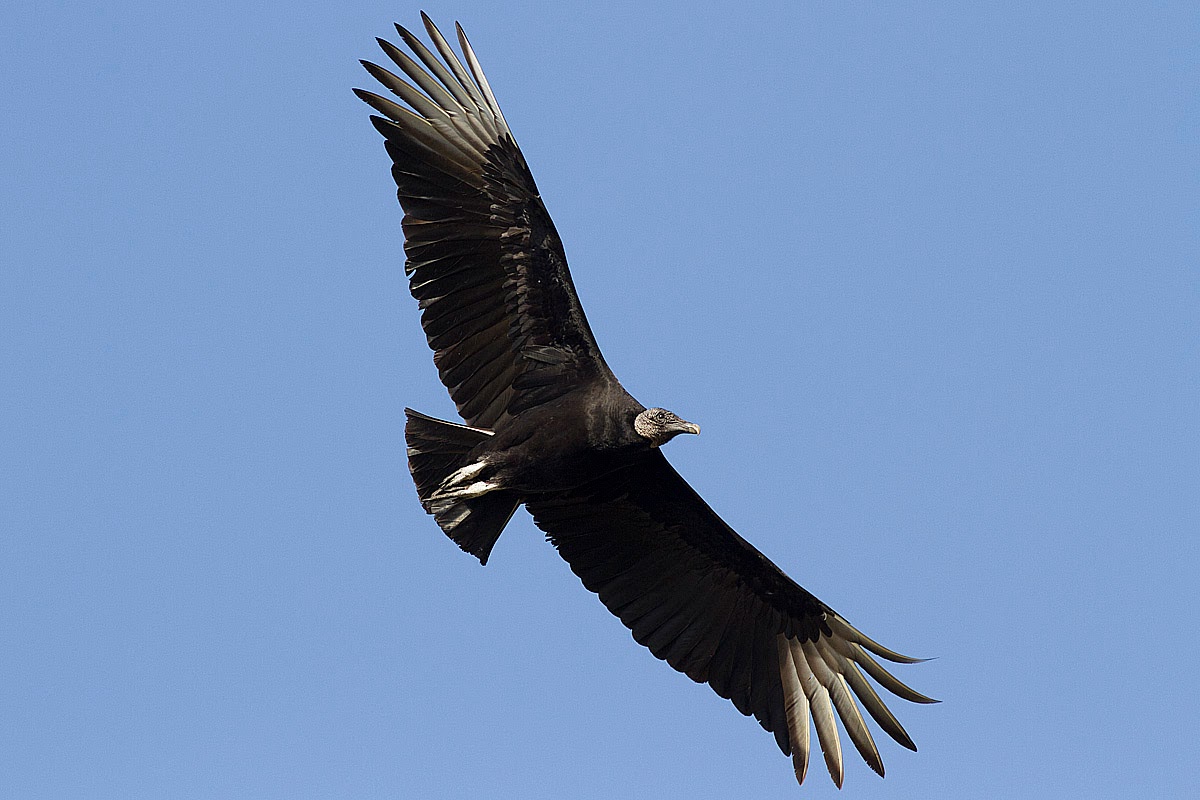
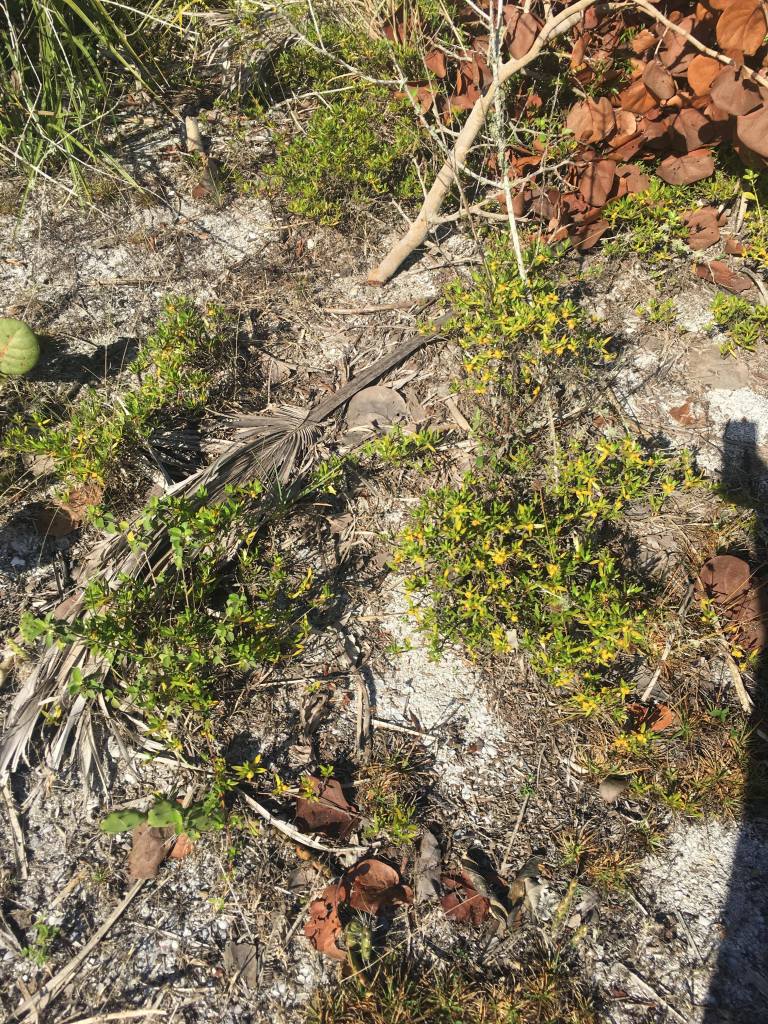
We were split into two groups and given a tour of the boardwalk, my groups tour guide was called Sharon. Sharon spoke about many plants and animal species that the Sanctuary holds: – Slash pines (Pinus elliottii) are a very fire resistant tree as they loose their limbs as they grow which prevent them from catching fire. – Saw palmetto (Serenoa repens), is currently the only species in the genus Serenoa and is endemic to the South Eastern US. Its another hardy plant when it comes to wildfires as it has thick trunks and a deep root system. Its a food source for the Florida Black Bears. The berries look similar to black olives. – We saw some species of Lauraceae family, which includes cinnamon and avocados. Unfortunately these are currently in jeopardy due to a disease outbreak and therefore those that are left are watched carefully and fruit from these trees are kept so when the disease has gone, plants can be grown from the seed stock. – Some differences between Black Vultures and Turkey Vultures were highlighted. Black ones fly higher, have a silver “window” at the end of their wings (underside) and a shorter tail. Also Turkey Vultures fly with their wings further out and “rock & roll”. Vultures eat dead material because they have weak feet and so cant carry food. When they get startled they regurgitate. – Love vine (Cassytha filiformis) is an obligate parasite. It’s called so as it has a reputation of being an aphrodisiac. It has no roots, and is yellow/ochre in colour with very small levels and fruits.
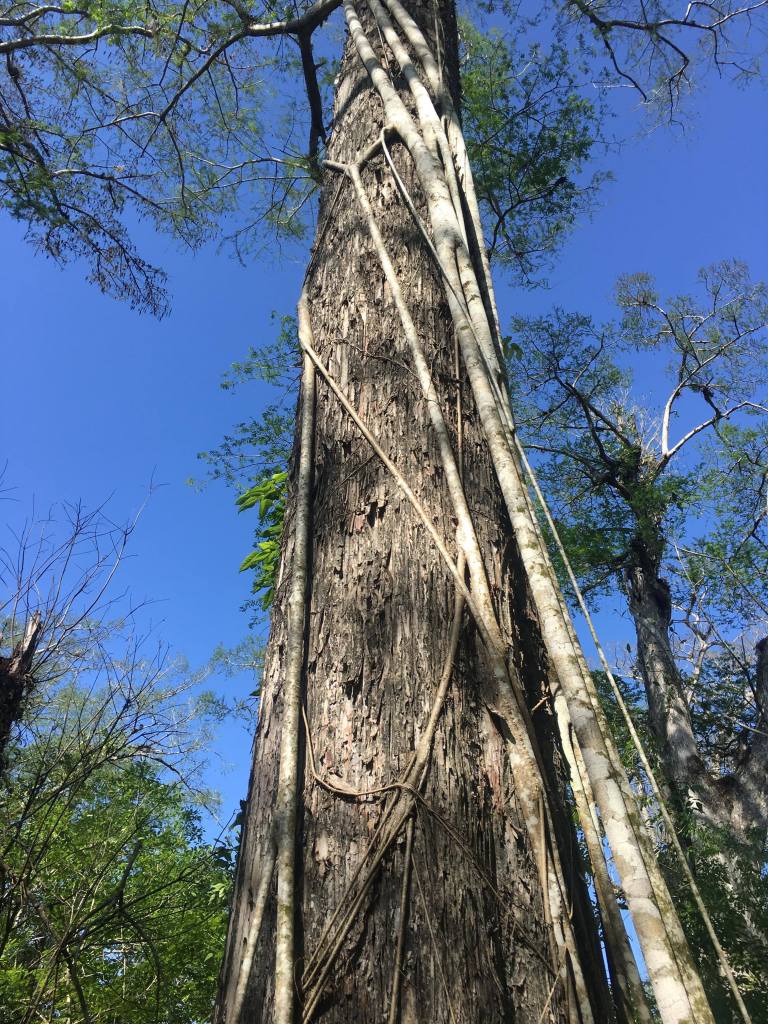
– Florida Strangler Fig (Ficus aurea). Birds eat the seeds but don’t digest them so essentially wherever they defecate is where a strangler fig will grow. It’s epiphytic (grows on the surface of a plant- not parasitic) until its roots are in the ground then its terrestrial (unless it was terrestrial to begin with) and eventually engulfs the host tree.
Strangler Fig
Photo: Ellie Short
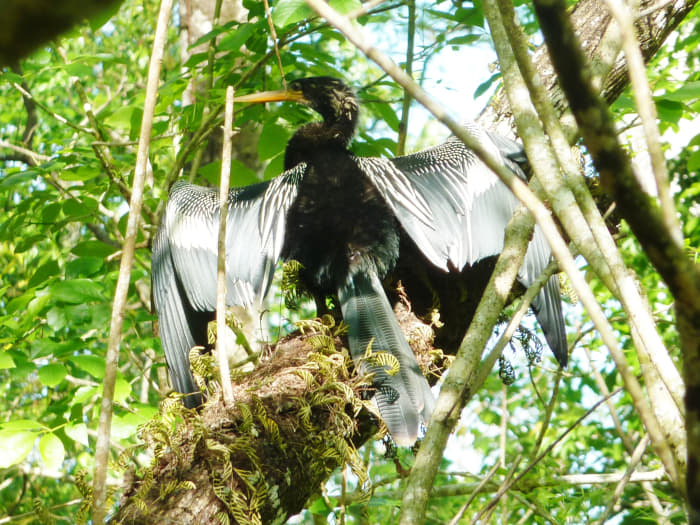
– Little Blue Heron (Egretta caerulea), wading in the water, hiding in flora. -Anhinga (Anhinga Anhinga). These birds have dense bones which help keep them buoyant. To dry themselves off they hold their wings out to the side. They get their name (which means snake bird in the Brazilian Tupi language) because when they swim only their long neck can be seen out of the water.
Anhinga
Photo: Haley Plumb
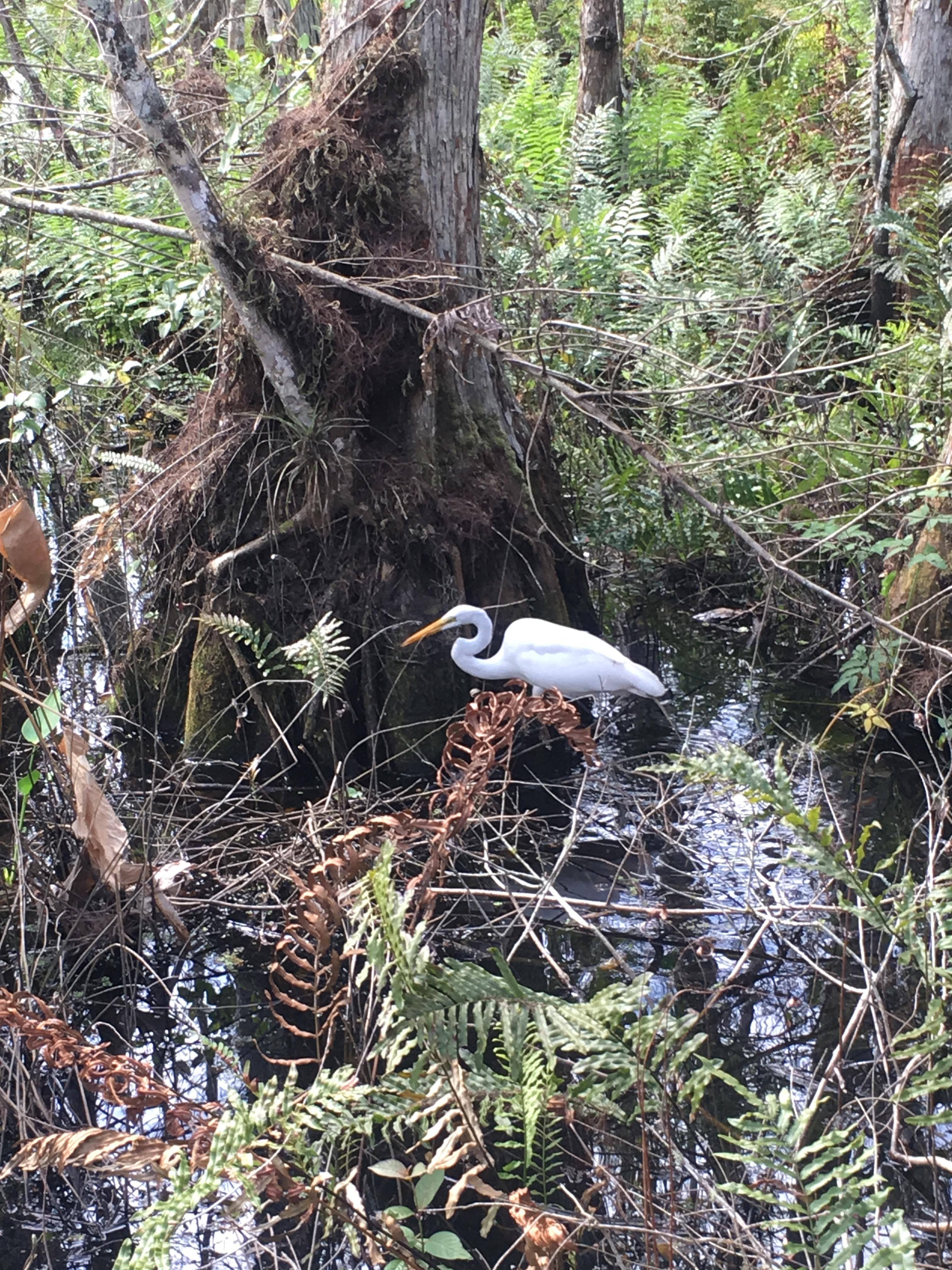
– Great Egret (Ardea alba). Lucky for us we got to witness one of these snowy white birds come up onto the boardwalk, it then moved off and stalked through the water, waving its neck from side to side.
Great Egret
Photo: Ellie Short
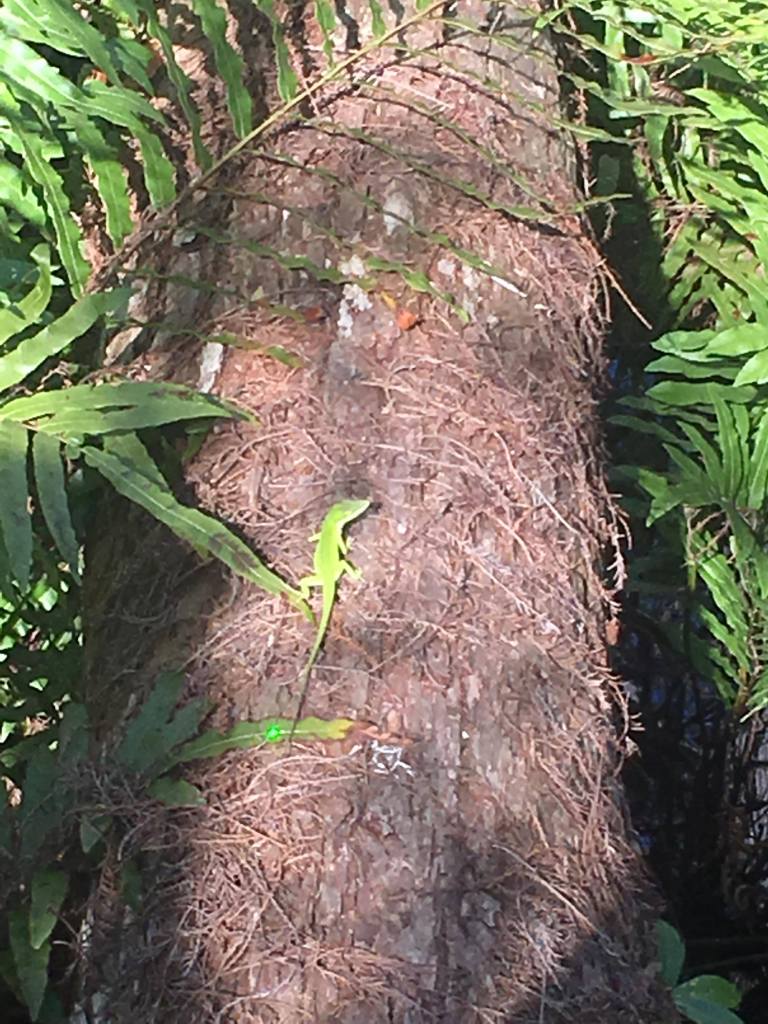
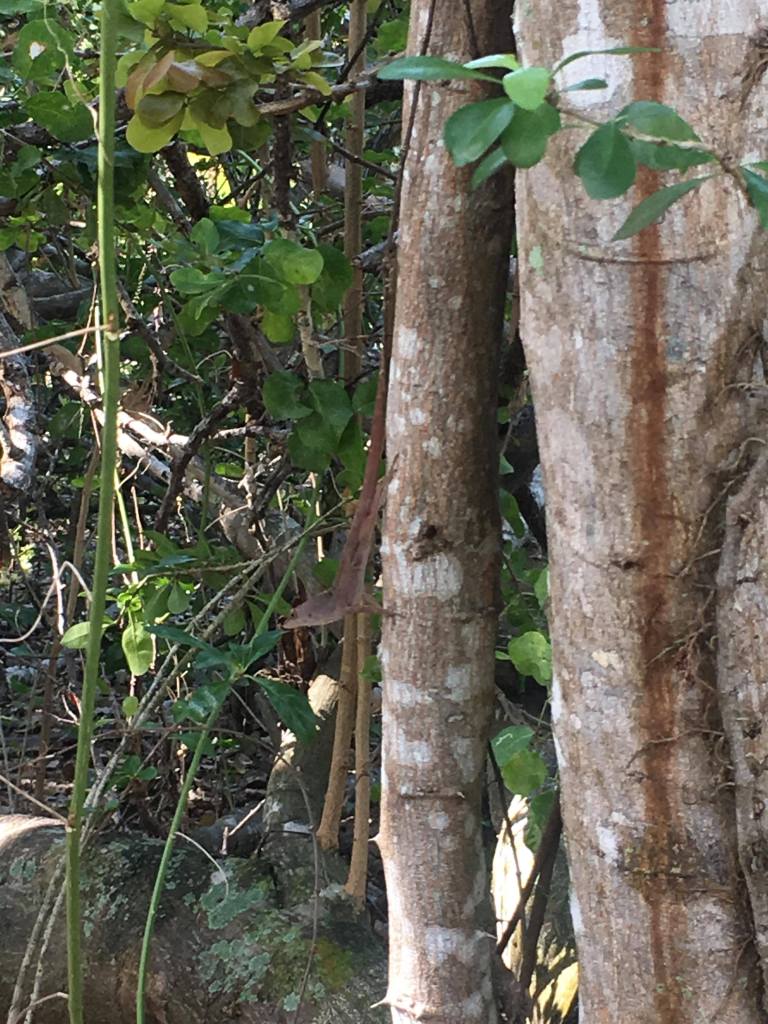
– White Ibis (Eudocimus albus), attempting to feed. – Green Anole (Anolis carolinensis). This native anole is a much rarer sight to see than the invasive brown anole.
Green Anole
Photo: Ellie Short
– Alligator (Alligator mississippiensis). Including a Juvenile.
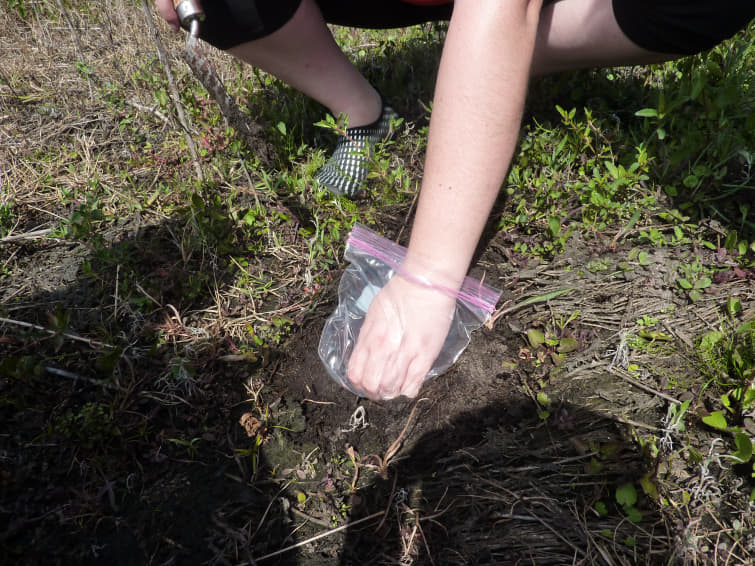
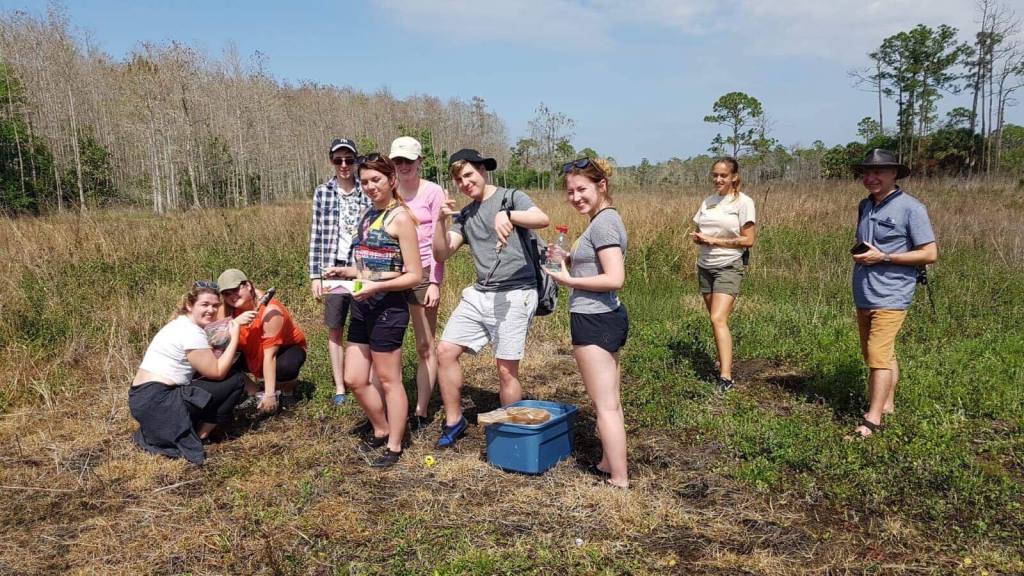
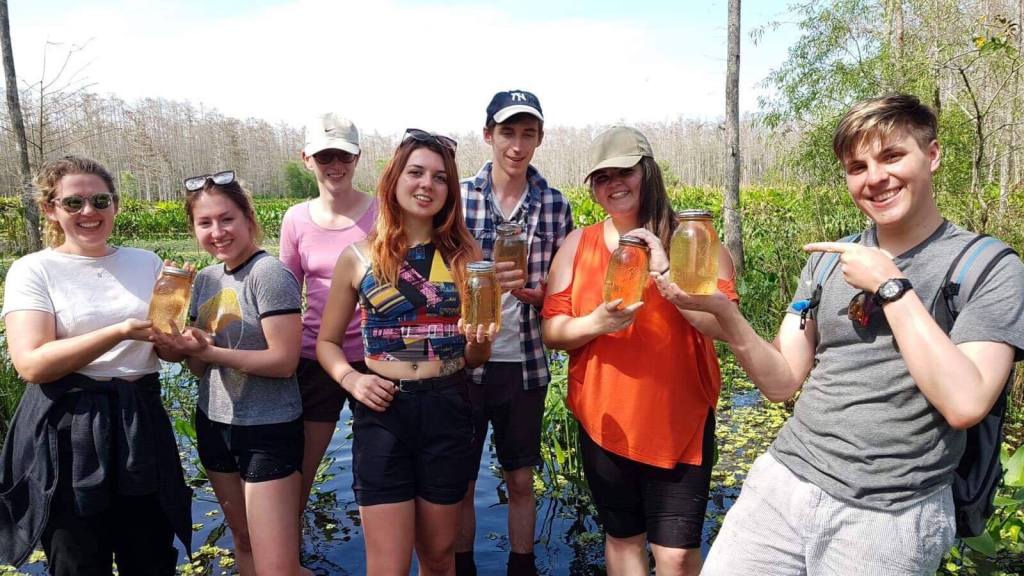
After our boardwalk a group of us went swamp wading to collect soil and water samples. This was a great opportunity to get some hands on experience in the field. We used plastic ziplock bags to collect the soil by grab sampling.
Grab Sampling
Photo: Haley Plumb
Soil Sampling
Photo: Christian Dunn
To collect the water sample we rinsed jars out at least 5 times and then filled them in still water so we got as little sediment as possible in the jars and then did the lids up underwater to ensure they were full to the top.
Water Samples
Photo: Christian Dunn
Corkscrew Swamp was definitely one of the most species rich days we had all week. It was incredible to see so much different flora and fauna.
The second day we spent at Lovers Key. This is part of a 1616 acre state park that used to only be reachable by boat (until 1965). It was originally destined to be made into a luxury condo site but was gifted to Florida for everyone to enjoy. Lovers Key State Park is made up of 4 barrier islands; Lovers Key, Black Island, Inner Key and Long Key.
As soon as we stepped out the minibuses we saw our first Turkey Vulture (Cathartes aura) fly overhead and also spotted Ospreys (Pandion haliaetus) in a nest they’d made on top of a lamp post.
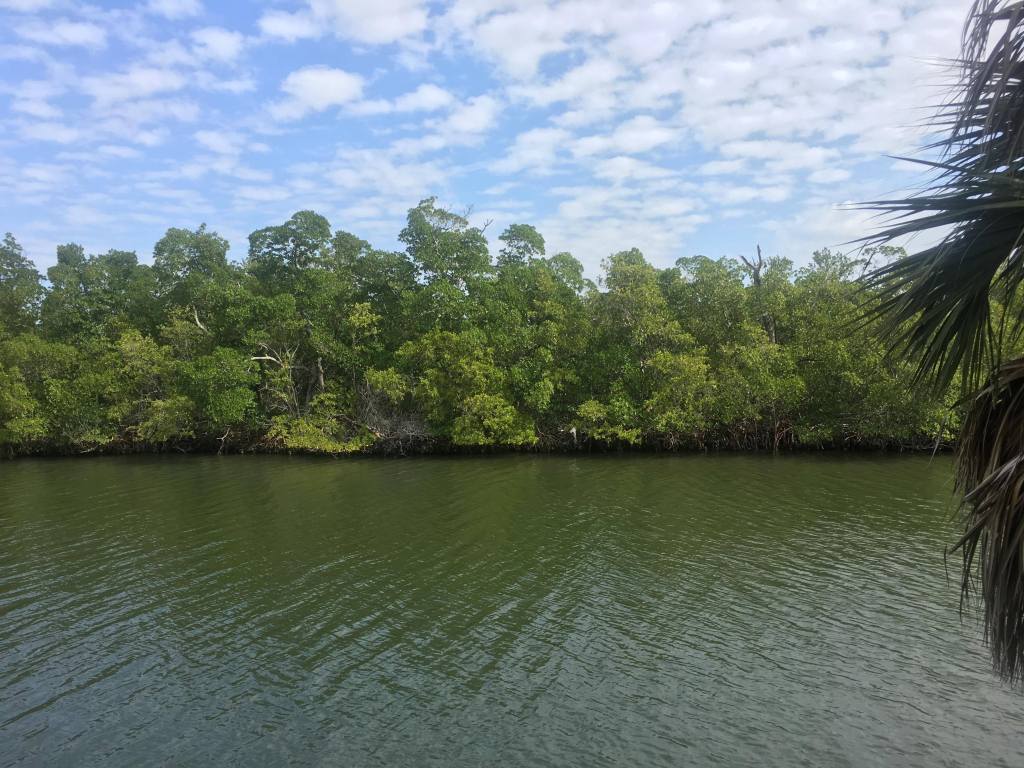
The Park has two main trails; Black Island Trail, that follows estuaries and canals- that were dredged for the original plan of development. The Eagle Trail goes through Maritime Hammock and passes through marine swamp where red and black mangroves can be seen. Along with the trails is a stunning 2 mile long beach.
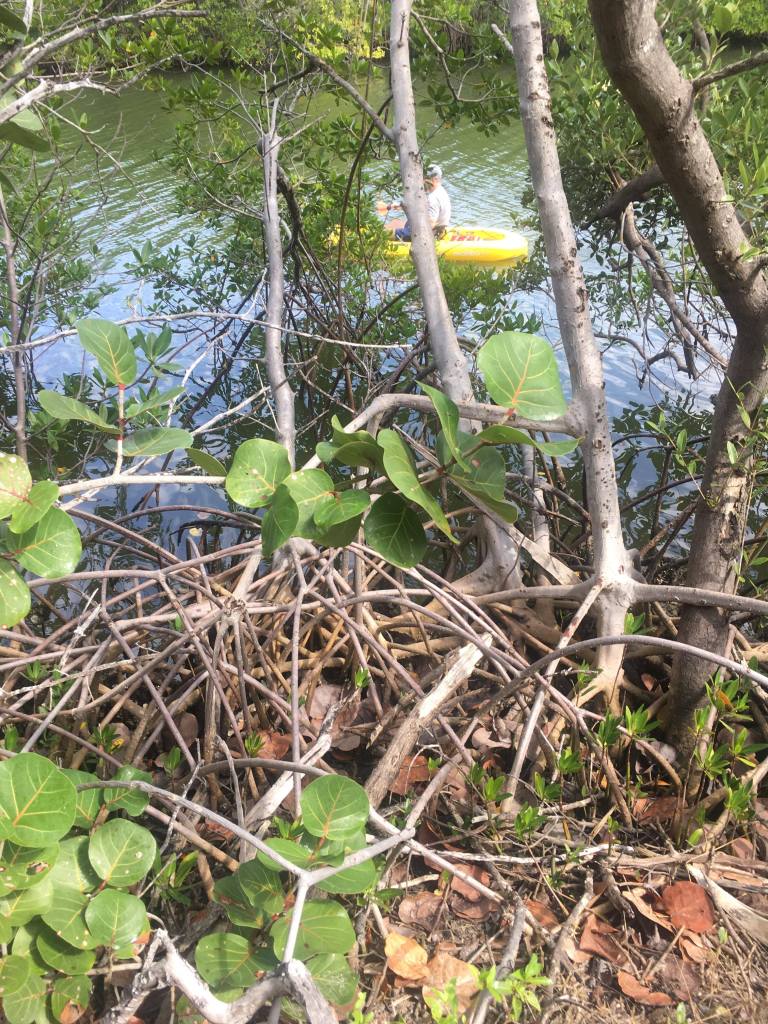
Christian Dunn (one of our lectures) gave us an introductory talk to mangroves and what to look out for on our walk. Red mangroves are the ones found closest to the water. They have a heavy root system and propagules that are live young that drop off the tree and float, when they hit mud they start creating roots. Because they’re already germinated they don’t need oxygen to start growing. The leaves of red mangroves are pointy and green on both sides and shiny. It has a dark red wood that’s covered by a grey bark. Black mangroves are second closest to the water, they have smaller propagules than red mangroves. It has very dark bark. Leaves are pointy like red mangroves but are less shiny. White mangroves are the furthest in land. Their propagules are very small. The leaves are more rounded than the other two and they have two bumps on the underside bottom of the leaves. These secrete a sugar/nectar solution. They have a mutualistic relationship with ants that protect them. The bark of white mangroves has scars on it.
Mangroves are great nurseries for young marine life as they act as protection and hold sources of food for younger animals. Mangroves can in fact live in freshwater but they’re the only plants than can fill the saltwater niche. Mangroves don’t reside in the UK because they couldn’t withstand the frost. Anymore than three days worth of frost and they’d be wiped out. With warming weather however, mangrove communities are spreading into salt marshes. It’s not yet been decided whether mangroves or salt marshes are better at carbon storing but evidence is leaning towards mangroves.
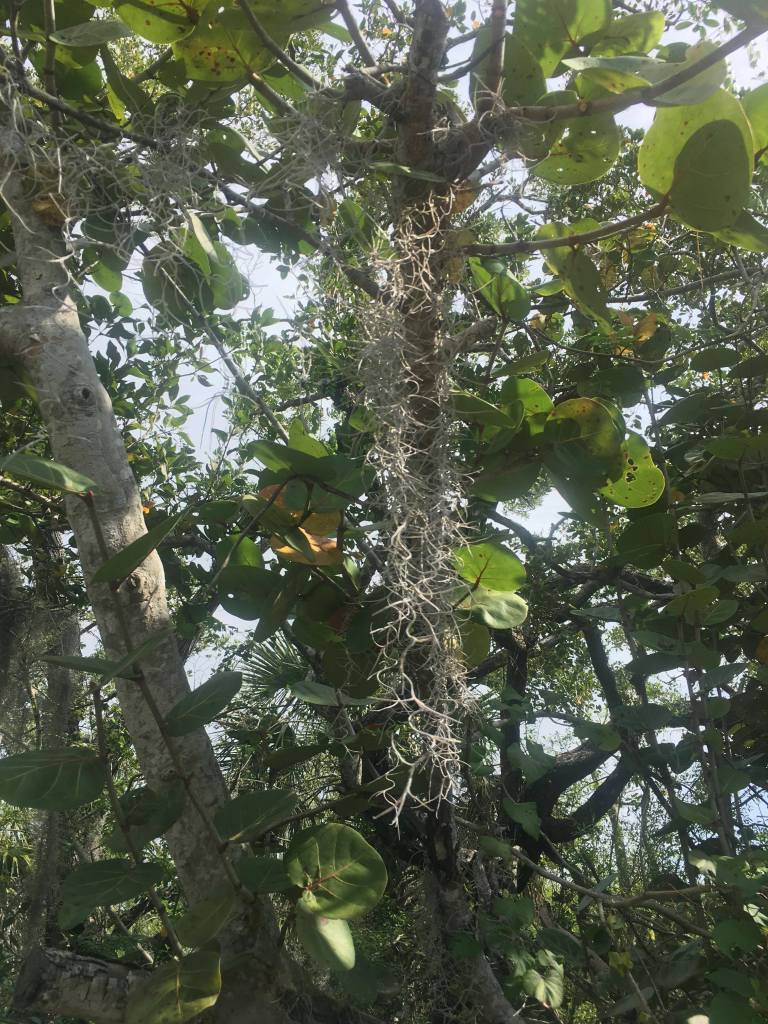
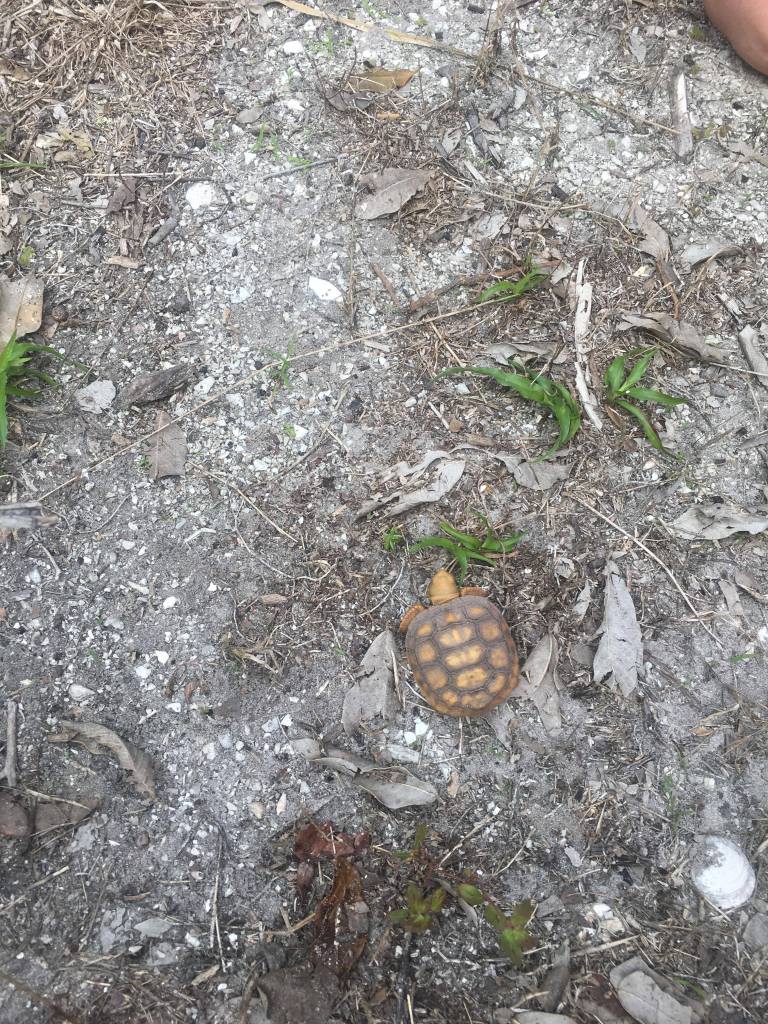
After our talk we went on a walk on one of the trails to see what we could find as well as to identify the different mangroves ourselves. – One of the highlights of the whole trip was definitely seeing a manatee (Trichechus manatus) pair floating in the water, we didn’t manage to get very close but it’s amazing being able to say we saw them. – Another Black Racer (Coluber constrictor Priapus) was seen skirting along a pipe in the butterfly garden but moved off into the bushes when we got too close. – A Brown Anole (Anolis sagreiwas) resting on a lower tree trunk. – Black Vulture (Coragyps atratus) flying over a body of water. – Crab-like Spiny Orb Weaver (Gasteracantha cancriformis), seen on it’s web. – Spanish Moss (Tillandsia usneoides) – Juvenile Gopher Tortoise, moving across sand and eating.
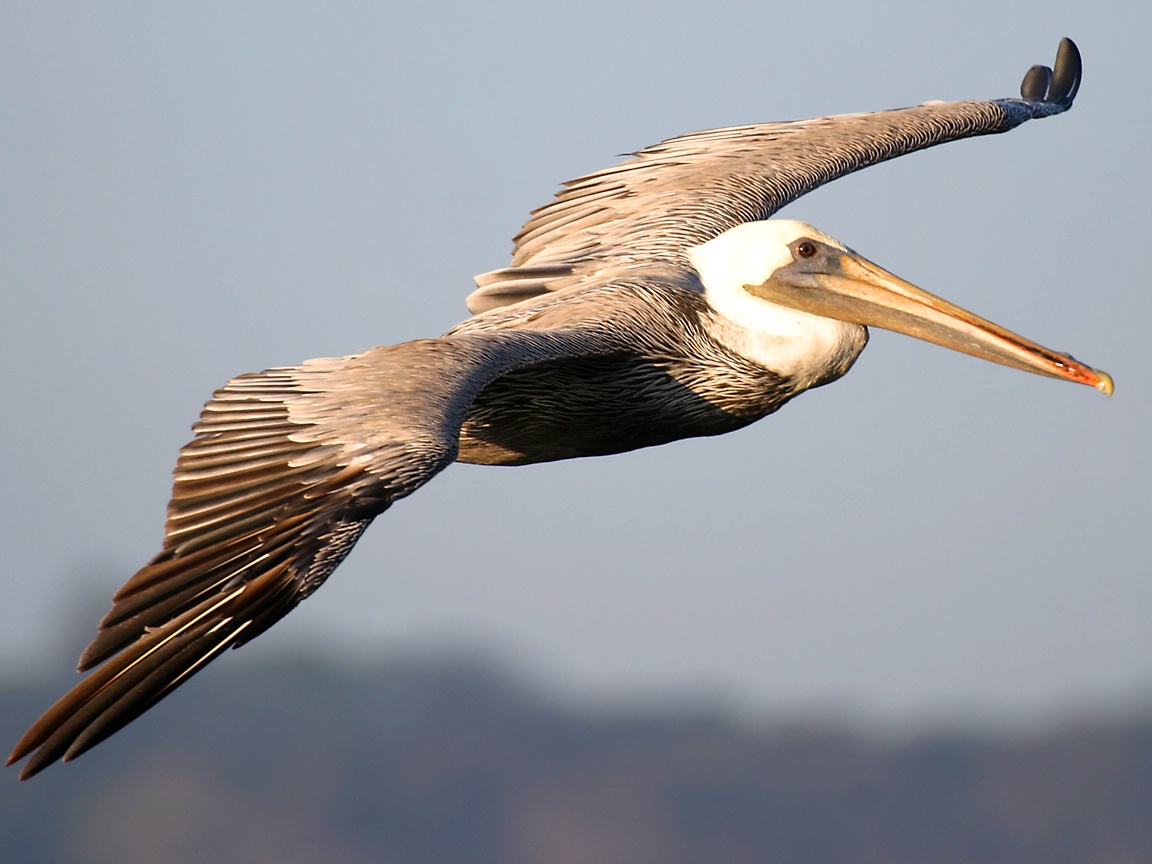
After our walk we spent time on the beach and had a swim in the sea. This is where we saw a few Brown Pelicans (Pelecanus occidentalis) fishing right next to us. A perfect way to end the afternoon.
23/02/19 To give some background behind these next couple of blog posts, I recently took a trip with a few course fellows from my university to Florida as a module option. We stayed at the Vester Marine Field Station in Bonita Springs, which is owned by the Florida Gulf Coast University.
The week kicked off at barefoot beach. This preserve is located just a 10-minute drive away from the field station. The park was established in 1909 and is 342 acres of natural land. Its owned by the State, however, 168 acres of it is leased to Collier County. Over 200 acres of the preserve is swampland.
Barefoot beach is one of the last undeveloped barrier islands on the Southwest coast of Florida. Barrier islands are stretches of land that lie parallel to the mainland, usually occurring in multiples. Barrier islands are very important as they can protect the mainland from storms and tidal activity.
Before our talk started we spotted a pair of Ospreys nesting, it’s towards the end of their nesting period so this was nice to see. Ospreys mate for life and live for approximately 25 years.
Pair of Ospreys nesting Photo: Ellie Short
We were given a talk by our guide Jimmy Trueluck. who is a “friend of barefoot beach”. The first thing he mentioned was “stabilising plants”, these are plants that hold sand together which are ultimately what help keep sandbars (natural submerged bars consisting of sand/other unconsolidated material) together, it’s these sandbars which can make up a barrier island. There are 5 different zones at barefoot beach: Maritime hammock Estuary system Coastal strand Foredune Upper shore
Maritime hammocks are found furthest away from the beachfront. They contain lots of stabilising plants and trees. One of which is Florida’s state tree- the Sabal Palm (Sabal palmetto). Also known as the Cabbage Palm or Tree of Life. It got the latter nickname due to its many uses. People used to use it for building houses, it produces sweet berries in the spring that can be eaten- these berries have a hard seed inside that can be ground down to make meal, fibre from the fronds were used to make fishnets as they’re very strong. Also the heart of the tree is edible and has a similar taste to cabbage (hence the nickname “Cabbage Palm”. This palm is protected. Palms are not actually trees. They’re monocots, in the family monocotyledoneae. Which in fact are related to grasses. Another tree found in this zone is the White Stopper (Eugenia axillaris)- another Florida native. This tree is sometimes called the Skunk Tree as it secretes an oily substance that some people think smells like skunk although others believe it smells like faint coffee. It’s been found to stop diarrhoea. The Gumbo Limbo (Bursera simaruba) is hard to miss with its dark red peeling bark- often referred to as the “Tourist Tree”. Another native tree, the sap of which is very sticky and was used as a natural glue, it was also used to catch birds which could then be eaten. The bark was used to seal wounds. Its a rapid grower and well adapted to several habitats including those with salty soils, because of these reasons and its low cost its often a recommended tree in regards to reforestation. It is one of the most wind-tolerant trees making it hurricane resistant and good for wind protection. It does produce fruit which is a capsule that encases a seed that’s covered in a red fatty aril (a seedcoat). Its this aril that is a food source to many birds including; the Masked Tityra (Tityra semifasciata) and the Bright-rumped Attila (Attila spadiceus). The Seven-year Apple tree (Genipa clusiifolia) has quite a misleading name as it takes the tree around one year to produce its fruit, not seven. They’re green, but turn black and wrinkled when ripe. The flesh of the fruit tastes similar to liquorice but the seeds are mildly toxic. It is a native tree in Florida but in South America the pulp is used as a body dye.
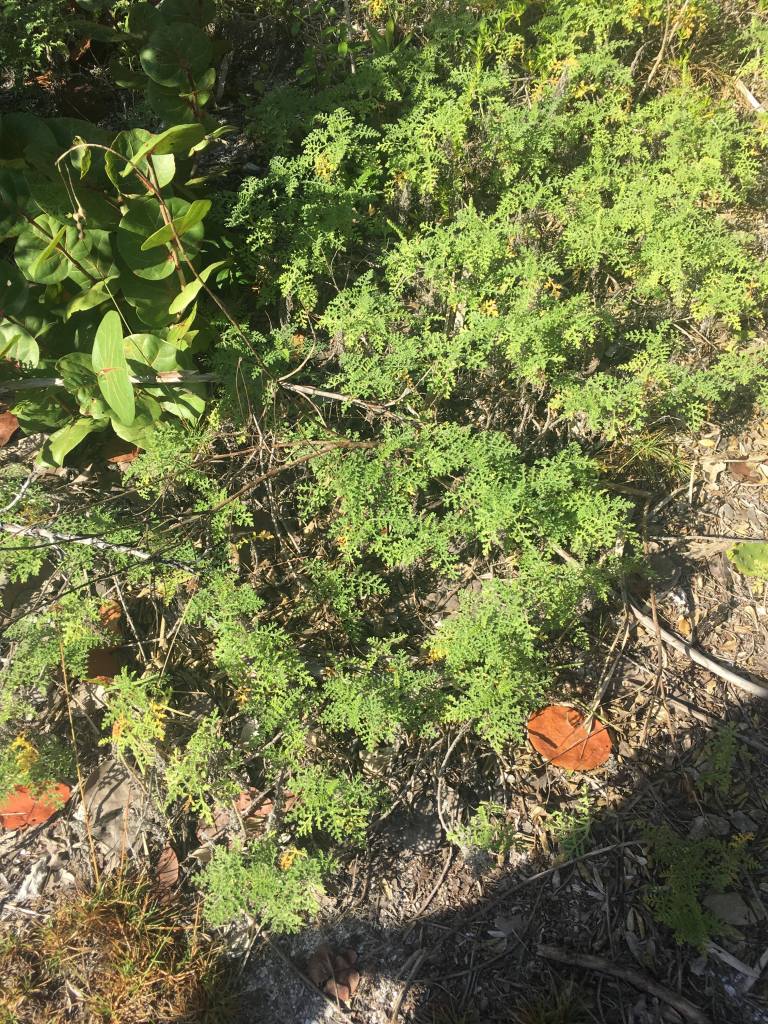
The next three plants are examples of soil stabilisers, also found in the Maritime hammock zone. Prickly Pear Cactus also known as Indian fig (Opuntia ficus-indica) is a Gopher tortoise favourite and the pads are edible to humans as well. It has red fruit due to betalains- red and yellow pigments. The gel-like substance in the pads used to be used for hair conditioner and to treat sunburn. Another is Golden Creeper or Beach Creeper (Ernodea littoralis). Surprisingly, this plant is in the coffee family. It’s tolerant of salt air but not salt water flooding. It produces small orange berries that birds feed on, they can be eaten by humans too and taste like apple. It spreads by its roots. It used to be used to treat whooping cough- which is where its nickname “coughweed” comes from. The last example is Coastal Ragweed (Ambrosia hispida). This again grows by its roots. It used to be used to treat malaria and fevers.
Prickly Pear Cactus
Photo: Ellie Short
Golden Creeper
Photo: Ellie Short
Coastal Ragweed
Photo: Ellie Short
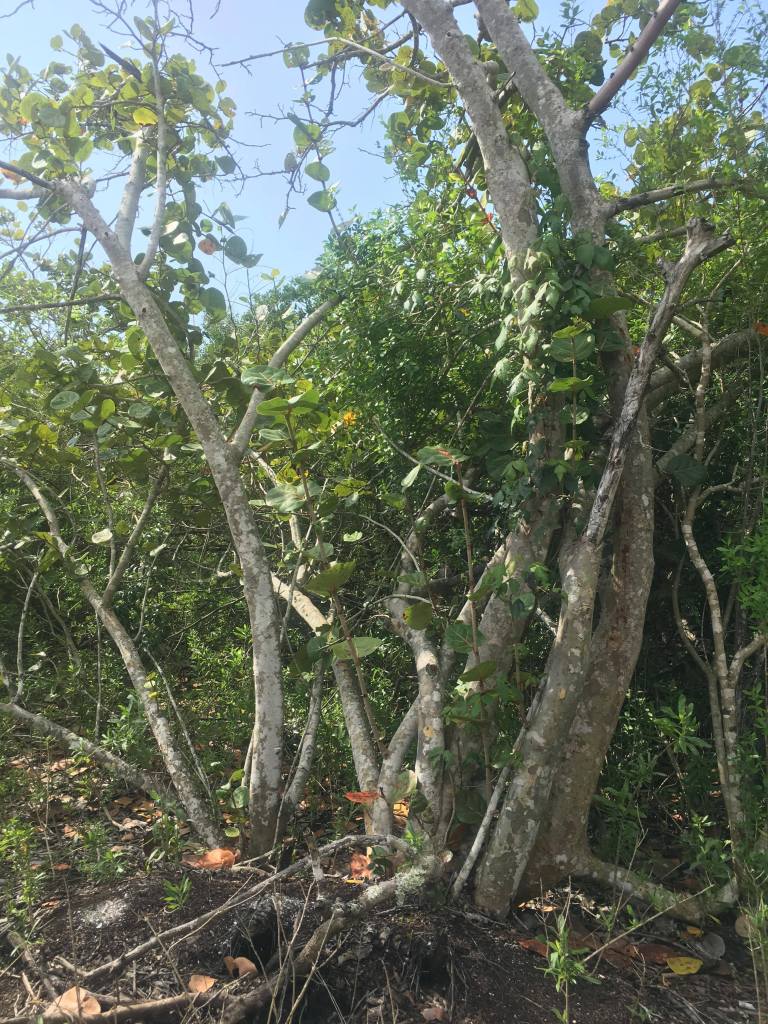
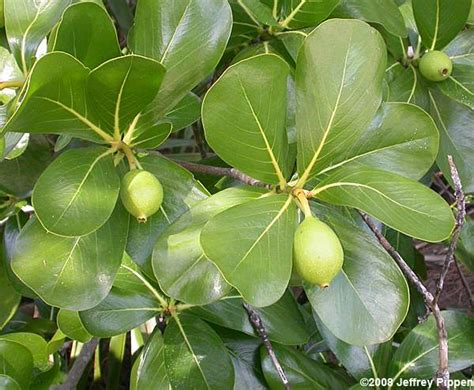
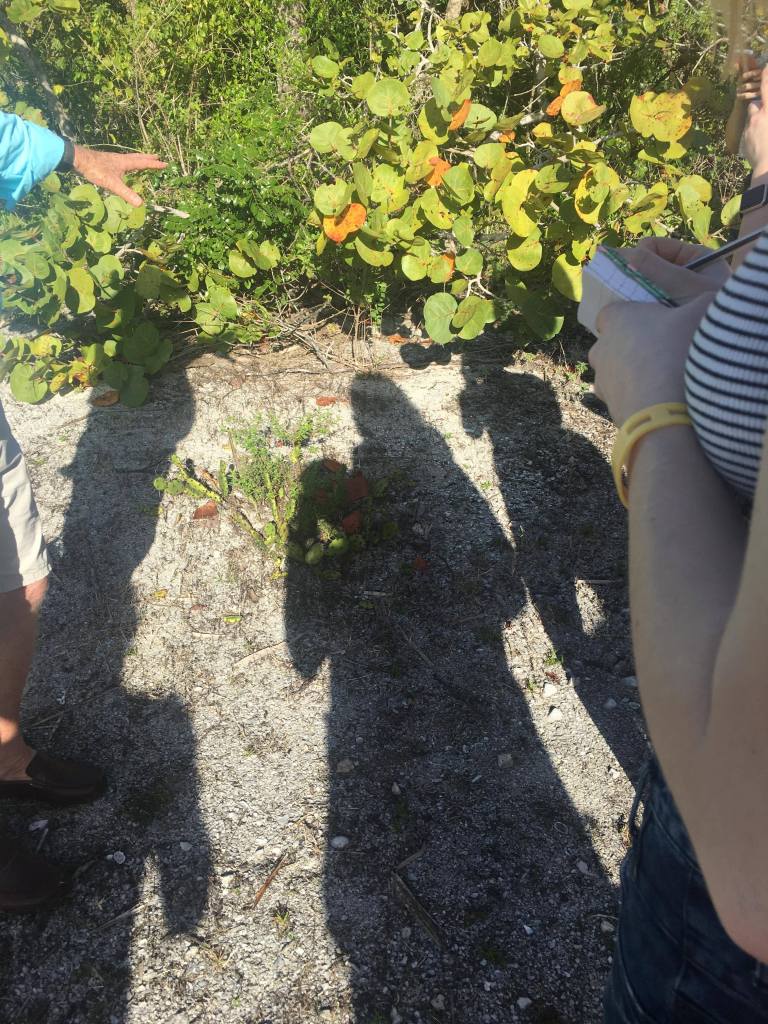
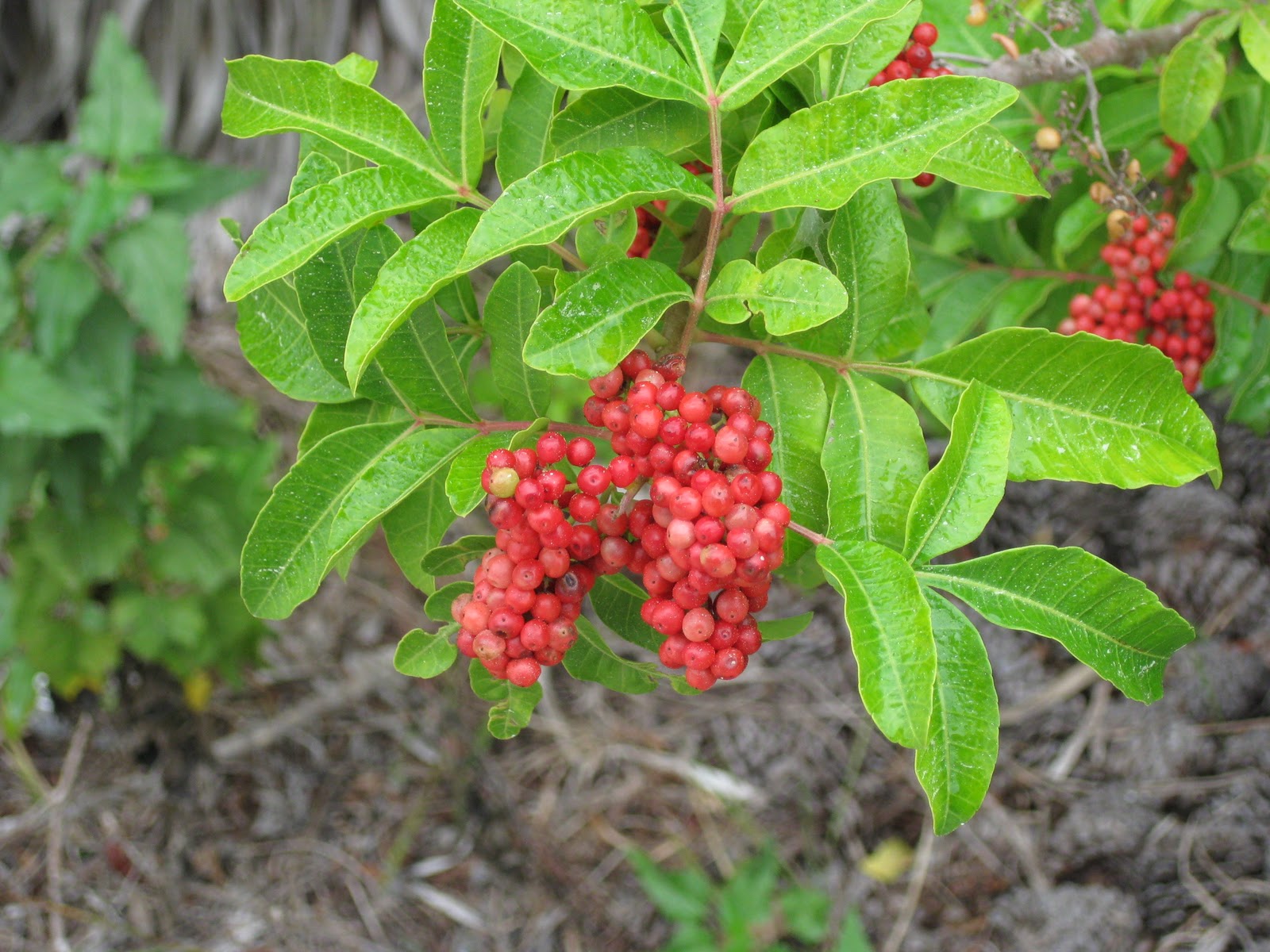
A few other species of plants we saw included the Sea Grape (Coccoloba uvifera), which is a member of the buckwheat family. Its named as its fruit looks like a bunch of grapes, they have a sweet-tart taste. Their leaves can grow up to 12inches in diameter and when they’re scratched it leaves a permanent mark. Also we saw an exotic invasive plant that the Preserve is trying to eradicate. The Brazilian Pepper (Schinus terebinthifolius) is a member of the cashew family and produces red berries, which are the reason the plant was imported originally. It has a resin that gives similar effects to that of Poison Ivy. Being a fast grower it makes it difficult to exterminate and it can only be properly killed by burning it, which can obviously have adverse effects on nearby native plants.
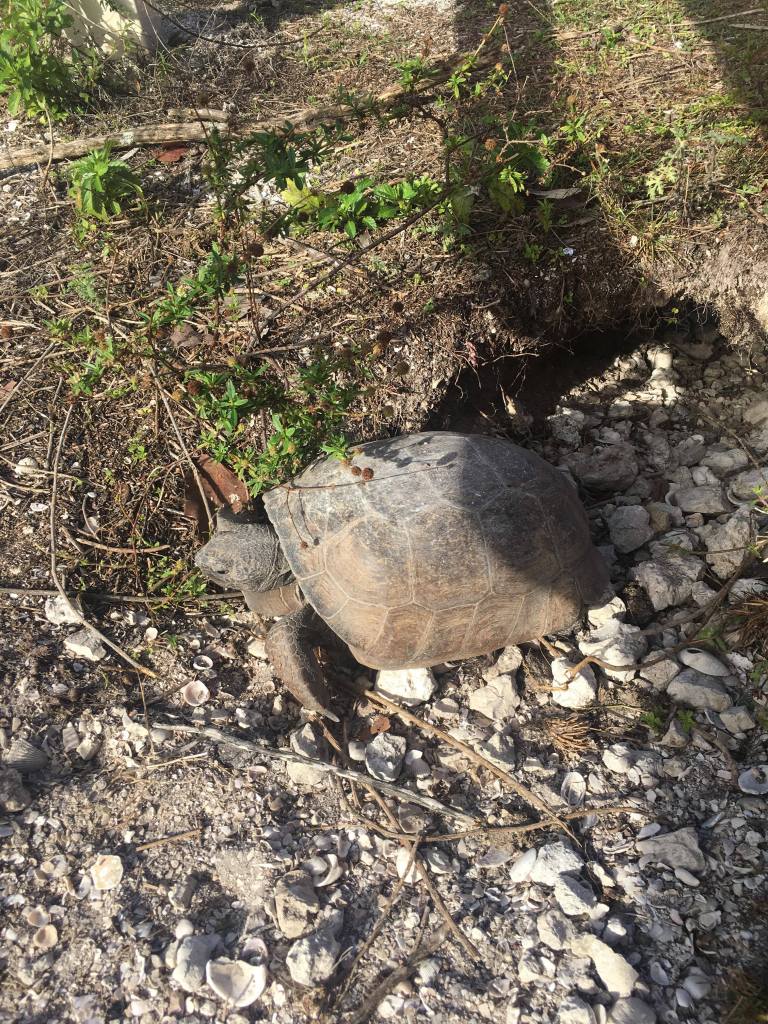
On our way to the next zone we saw our first of many Gopher tortoises (Gopherus Polyphemus) of the trip. It was around md-morning and this is the usual time that the tortoises come out of their burrows as its warming up outside. These tortoises bury until they hit ground water, this helps them control their body temperatures as they are cold-blooded. They can be quite helpful as during hard weather times they quite happily share their burrows with up to 300 different species of insects and animals. They have a lifespan of 60 years in the wild and over 100 in captivity. These are solitary animals but males will come to the entrance of female burrows to breed. The females will lay 5-7 eggs just outside of the burrow.
Gopher Tortoise
Photo: Ellie Short
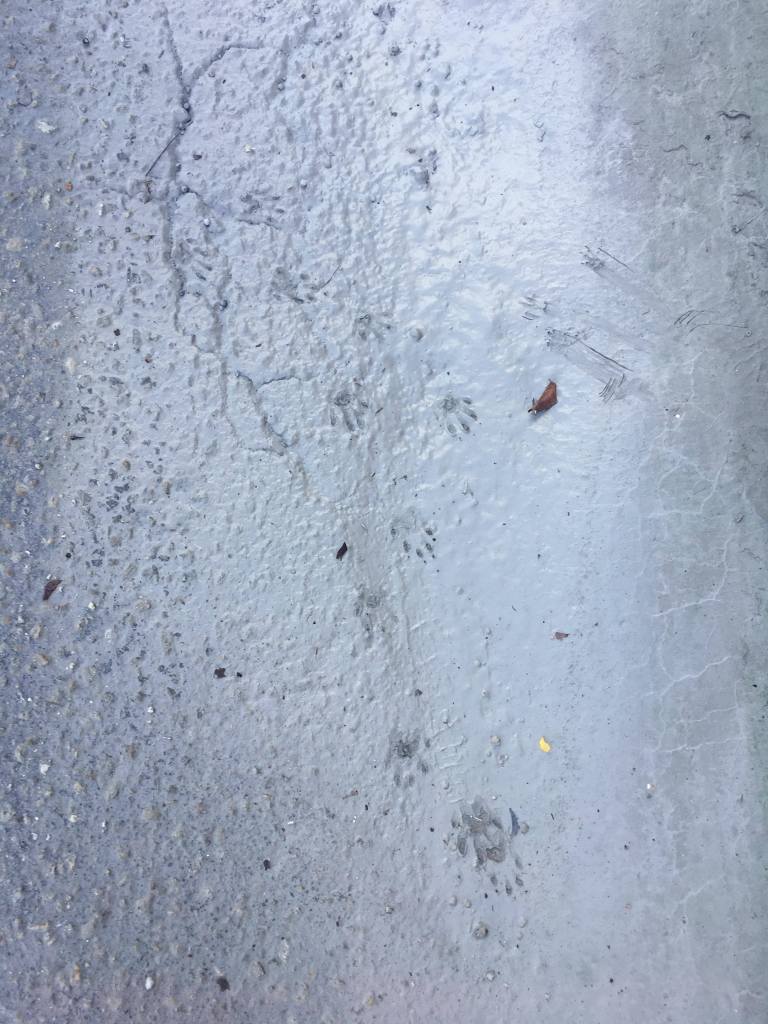
We also saw some raccoon tracks and a glimpse of a raccoon disappear into the bushes. A Black Racer snake was seen on the mound by the Gopher Tortoise unfortunately I couldn’t snap a photo of it.
Raccoon Tracks
Photo: Ellie Short
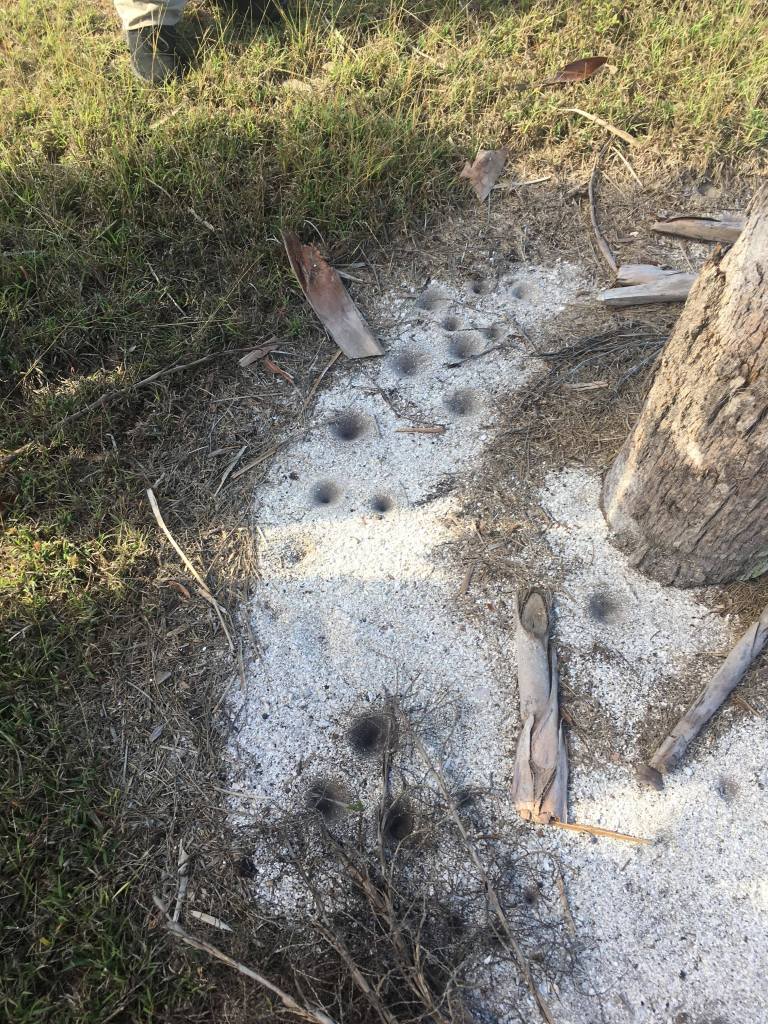
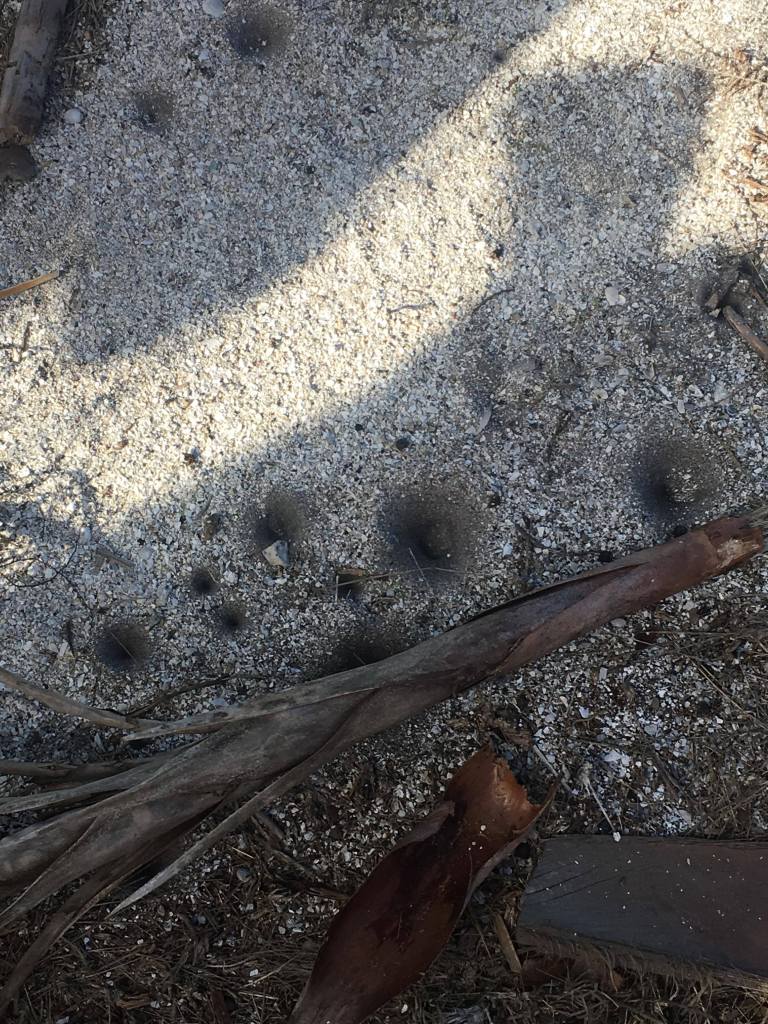
Jimmy pulled us to one side to talk about some strange holes in the ground around a tree. They turned out to be holes created by Antlions, an insect in the family Myrmeleontidae. These insects are not ants, but called so because the sinkholes they create are to trap ants and other small insects.
Antlion holes
Photo: Ellie Short
We reached the Estuary zone next. An Estuary is an enclosed body of water where freshwater meets seawater. Its often referred to as “The Cradle Of The Sea”, as many young fish and mammals are raised in its brackish waters. Mangroves are common alongside estuaries (these will be discussed in more depth in a different post!).
The Coastal Strand is between the Maritime Hammock and Foredune zones. The Coastal Strand is a plant community that’s along the shore in loose sand and before the high tide line. Foredune is a dune ridge that runs parallel to the shore. The final zone is upper shore where a lot of seaweed and wrack can be washed up. This is the first part of the beach. This concludes my first day of the trip at Barefoot Beach!


.gif)









 Life of El
.gif)